NEW ISSUE
[ It Was A Fine August Day in 2017 ]
OUT NOW
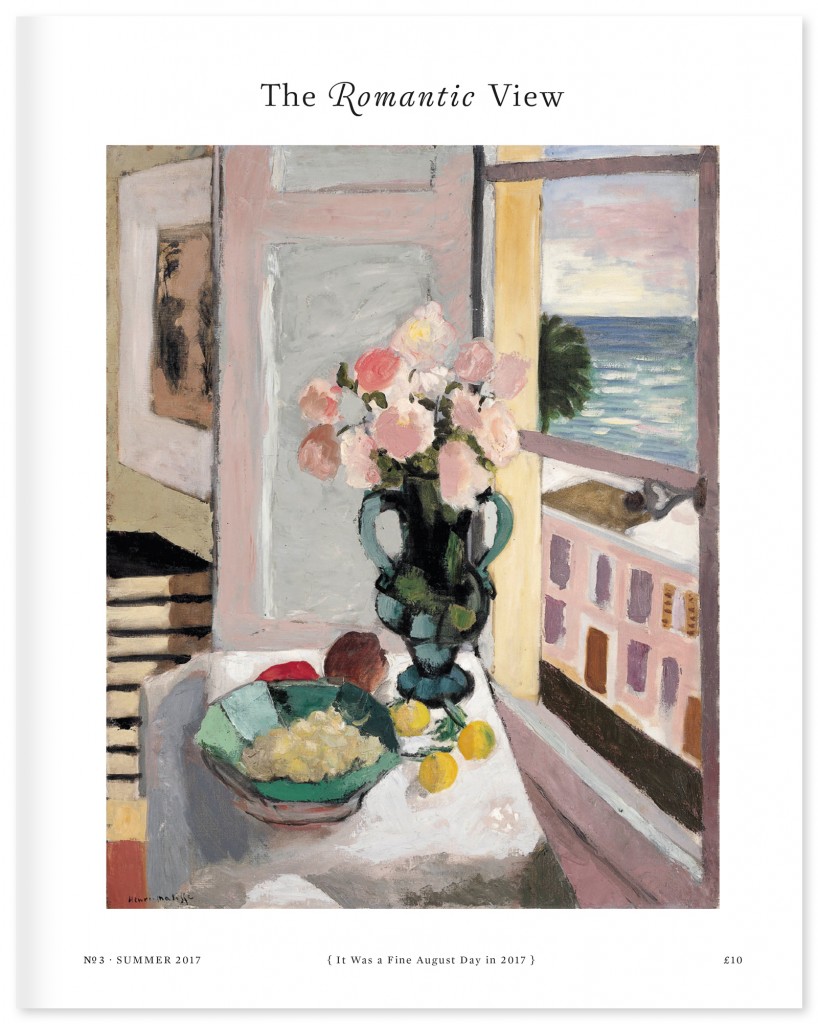
The Romantic View is a seasonal arts magazine established in London in 2015 by
The magazine is designed by Tim Barnes whose thought to typography, page design, the hue, feel and the quality of the page contribute to the reader’s literary pleasure.
The Romantic View aims to reflect upon and express the art, ideas, impressions and mood of the season bringing both the old and the new intimately together while vigilantly distinguishing differences, uniqueness, parallels and recurrences in the new situation from the old and in the different realms of artistic expression.
The front and back cover of each magazine is devoted to the work of a painter who welcomes us into each season with a lyrical, painterly expression of colour and texture, landscape and nature, from Egon Schiele’s sensuous flesh and delicate fabrics in our inaugural issue, to the intoxicating flowers and luxurious dappled sunshine of Monet’s waterlilies or Matisse’s salmon pink roses in our current issue.
Romanticism was first conceived in the art form of the English Landscape Garden in the 17th century and The Romantic View aims to immerse the reader in lush, romantic gardens or languorous landscapes whose natural beauty has long lured intellectuals, painters, musicians and poets. But Romanticism is restless, deriving its energy and beauty, its joy and melancholy, grandeur and decay from societies in flux, and so The Romantic View endeavours to meander after the Romantic Imagination from the hazy gardens and lakes of England, during the Industrial Revolution, to Paris, during and after the French Revolution, to the German Romantics and late 19th century Romantic composers, as we delve deeper into Romanticism and its impact on the birth and development of modern art.
All modern art has its roots in Romanticism and Romanticism has its roots in the birth of our modern society that came to its full development with the French Revolution. From this point onwards Romanticism had its more diffuse and more creative moments but the great fortune of some of us was to be adolescent during the latter — during the exhilaration and super abundance of the New Romantic movement. We could absorb the newness and nowness of beautiful new sounds — Gustav Mahler’s Adagietto from Visconti’s Death in Venice, Kraftwerk’s Franz Schubert, Neu!, Wolfgang Riechmann, Ultravox and Visage, Japan and Yellow Magic Orchestra — brought to us via Rusty Egan and Steve Strange’s Club For Heroes at the Blitz Club in London. A sound and vision was being created out of brilliant new colours not yet distinct and that gave voice to artistic aspirations that our generations (or later) could voice or reinvent as their own. Musicality, sound and the voice of the artist lies at the heart of The Romantic View magazine.
Music … is romantic poetry for the ear. Like the beautiful without a limit, this is less a delusion of the eyes, of which the boundaries do not fade away as indeterminably as those of a dying sound. No colour is as romantic as a sound, since one is present at the dying away only of a sound but not of a colour; and because a sound never sounds alone, but always threefold, blending, as it were, the romantic quality of the future and the past into the present.
Jean Paul [1763–1825]